

Insights from a recent study on sand erosion performance
Durability in utility scale solar is often discussed in terms of corrosion resistance, but many solar projects face another equally important challenge that receives far less attention: sand abrasion. In dry, windy regions, blowing sand and dust continuously strike exposed steel components, gradually wearing away protective coatings through repeated particle impact. This process occurs even in very low moisture environments and can significantly influence how long structural steel remains protected.
For utility scale solar projects designed to operate for 25 to 35 years, this matters. Structural components such as piles, posts, tracker torque tubes, and racking members are exposed every day to airborne particles driven by wind. Over time, sand abrasion can thin or remove coatings, eventually exposing the underlying steel. Once that happens, corrosion can begin, increasing maintenance risk and potentially shortening service life.
A recently published study, Surface erosion damage in mounting structures of large-scale photovoltaic systems”, helps clarify how different Zinc coatings perform under abrasive conditions. While some coatings exhibited lower erosion rates under certain test conditions, the study shows that erosion rate alone does not determine durability. When coating thickness and wear behavior are evaluated together, hot dip galvanized steel (HDG) was shown to last approximately 3.58 times longer than continuous galvanized steel (Z275) and 6.63 times longer than zinc magnesium aluminum alloy coated steel (ZM310) before full coating loss occurred.
Interestingly, the key implication of the research is not emphasized in the formal conclusions section of the paper. As noted in the discussion section, the authors state:“It is therefore expected that, over time, HDG samples will demonstrate the highest erosion resistance of all the Zn-coated samples.”
Overview of the study and coatings evaluated
The study focused specifically on photovoltaic mounting structures and evaluated erosion performance of metallic coatings commonly used in solar applications. The coatings included hot dip galvanized steel (HDG), continuous galvanized steel (Z275), and a zinc magnesium aluminum alloy coating (ZM310).
Coating thickness establishes the durability baseline
The erosion results in this study cannot be interpreted without first understanding coating thickness. Table 2 makes clear that hot dip galvanized steel provides a substantially larger protective reservoir, with coating thickness approximately five times that of continuous galvanized steel (Z275) and four times that of the zinc magnesium aluminum alloy coating (ZM310).
Because abrasion removes material over time, coating thickness effectively represents the amount of protective material available before the underlying steel becomes exposed.
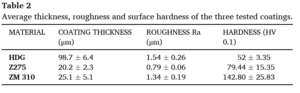
This difference is critical. Erosion resistance describes how quickly material is removed, but coating thickness determines how much protective material is available to be removed before the steel substrate is exposed. Thickness sets the baseline for durability.
Erosion rate versus time to coating loss
The study used a free falling sand erosion test to quantify material loss rates, reported in Table 3. Under this test, continuous galvanized steel (Z275) exhibited a lower erosion rate at 4.03 micrometers per hour, compared to 5.52 micrometers per hour for hot dip galvanized steel (HDG) and 9.43 micrometers per hour for the zinc magnesium aluminum alloy coating (ZM310).
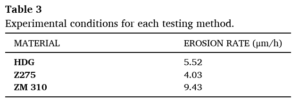
When erosion rate is viewed alone, Z275 appears to perform best. However, when erosion rate is evaluated together with coating thickness, a very different picture emerges. Using the measured erosion rates and coating thicknesses, the study shows that it would take approximately 17.9 hours to fully remove the hot dip galvanized coating, compared to roughly 5 hours for continuous galvanized steel and 2.7 hours for the zinc magnesium aluminum alloy coating under the same test conditions. This corresponds to hot dip galvanizing lasting approximately 3.58 times longer than continuous galvanized steel and 6.63 times longer than zinc magnesium aluminum alloy coated steel in the free falling sand erosion test.
Despite a slightly higher erosion rate, the substantially thicker hot dip galvanized coating results in a much longer time to full coating loss and steel exposure.
Erosion behavior and layered coating structure
The study also evaluated erosion behavior using a forced air sand impingement test, with coating loss trends illustrated in Figure 9. The results demonstrated that the hot-dip galvanized samples will demonstrate the highest erosion resistance among the zinc-coated systems evaluated.
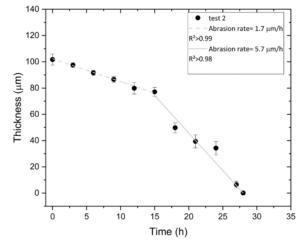
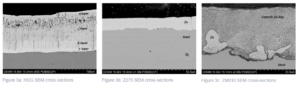
Hot dip galvanized coatings consist of multiple zinc iron intermetallic layers, each with different mechanical properties (Figure 3a). As the outer layer is removed, underlying layers are exposed. In real world conditions, new harder zinc patina layers can also form over time, potentially increasing resistance to further degradation. Accelerated testing that averages erosion across all layers may therefore not fully represent long term field behavior.
In contrast, continuous galvanized steel (Z275) does not contain intermetallic layers, and the zinc magnesium aluminum alloy coating (ZM310) contains only a single intermetallic layer. (Figure 3b&c)
Hardness does not predict abrasion resistance
Another key finding of the study is that coating hardness does not correlate directly with abrasion resistance. The zinc magnesium aluminum alloy coating (ZM310) exhibited the highest hardness of the coatings evaluated, yet it also showed the highest erosion rate and the shortest time to full coating removal.
This highlights that hardness alone is not a sufficient indicator of abrasion resistance.
The results reinforce the need to evaluate coatings using a broader range of mechanical performance metrics, including coating thickness, ductility, toughness, layer structure, and how the coating responds to repeated impact and material loss.
Taken together, the findings suggest that abrasion resistance is governed by a combination of properties rather than hardness alone.
Surface cracking observed in zinc magnesium aluminum alloy coatings
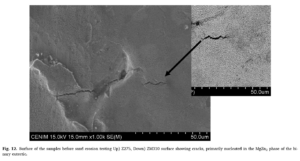
Microscopic examination further differentiates coating behavior. Figure 12 shows surface cracking present in the zinc magnesium aluminum alloy coating (ZM310) prior to erosion testing, with cracks growing after testing. These pre existing and propagated cracks create preferential paths for material removal and may accelerate degradation under abrasive conditions.
No similar cracking behavior was observed in the hot dip galvanized or continuous galvanizing coatings.
Implications for harsh solar sites
Taken together, the study demonstrates that coating performance cannot be evaluated using a single metric. While continuous galvanized steel (Z275) showed a lower erosion rate, hot dip galvanized steel provided substantially longer overall protection due to its greater coating thickness, multi layer structure, and mechanical behavior under abrasion.
For harsh solar sites where wind driven sand, long design life, and limited maintenance access are realities, durability must be evaluated based on total coating life under combined exposure mechanisms, not erosion rate alone. Sand erosion, coating thickness, intermetallic structure, and mechanical response all play critical roles in long term performance.
This makes hot-dip galvanizing a strong choice for solar projects built in challenging environments.
Reference
De Damborenea, J., Conde, A., Bernal, P., Ortuño, F., Pinto da Silva, C., & Arenas, M. (2026). Surface erosion damage in mounting structures of large-scale photovoltaic systems. Solar Energy Materials and Solar Cells, 298, 114121. https://doi.org/10.1016/j.solmat.2025.114121